Showing posts with label mountain biking. Show all posts

Friday, 29 May 2015

The Most Important Bike Related Study In History

Now I'm the first to admit that when it comes to technology I'm generally a total luddite.  I could not give a shit about your latest phone, I have no apps and my TV is still deeper than the screen is wide. I find nothing more tedious than having to listen to 21st century bores extolling the virtues of the shiny and new, except that is when it comes to bikes.  For some reason it's my one weak spot where the latent consumerist tendencies boil up in me and I involuntarily find myself emptying my Paypal account because my stem is 5mm too long or my helmet is the wrong colour.

I've been biking for a loooong time now and it was whilst gathering bits together for a retro project build (disguised as a new bike for my wife to ride) that I realised that nobody in history has done a proper in-depth comparative study between the old school and the modern.  It's probably because the writers of the world are too scared of the evil superpowers of the corporate biking behemoths who'll ruin their lives if they threaten the inevitability of 'progress'.  Or perhaps it's fear of the realisation that they've essentially wasted thousands of pounds on kit that's made them no better riders whilst simultaneously ruining their spousal relationships and denying their kids the chance of a Third Level education.

However, I'm not afraid.  My kids are still young and my wife knows I squander a fortune of our retirement fund.  So I'm going to face into the epic task and produce the World's first definitive bike technology study and answer the question that everyone needs the answer to, 'is new bike technology a bit shit?'  Before I start can I make it clear that this isn't a discussion, everything in this entirely objective piece of work is FACT.  You can disagree but you're wrong, deal with it.

So here goes, wish me luck...

Back when Bontrager wasn't just part of the Trek corporation
Frames - 
So back in the day (you'll hear that at least 100 times in this piece!) frames all looked the same. They were made of steel and had 89 degree head angles and were all welded and had bottle cage mounts and some even had rack mounts for 'touring'.  Some were truly things of beauty (Bontrager, Chas Roberts, Fat Chance etc) but the similar appearances made it too hard for punters to tell that you'd spent a fortune on one which definitely limited your chances to look cool.  Then came titanium, aluminium, magnesium (Kirk Revolution anyone?!) and carbon and everything went mad.  Without even mentioning suspension (until the next section), slacker angles, integrated ISCG mounts, tapered head tubes etc have all incrementally improved the beating hearts of our bikes.  Frankly, if you'd shown me my Nomad C back in 1988 I'd have imploded.  Frames are lighter, better handling and displaying previously unimaginable degrees of versatility and so it's definitely a point for the new school.

EXCEPT...

Back in the nineties you bought a new frame and transferred all your old parts, easy.  Kids these days would laugh at that concept.  'Oh no, my forks have the wrong steerer, my headset isn't integrated, my bottom bracket has threads, my seatpost is a 30.9, my disk mounts are wrong', pass me the pills!! Gone are the delightful days of being able to waste hours in your garage plugging together a new build, replaced by hours of poring over CRC and BikeDiscount.de to save a few quid on extras you'd not budgeted for.  New builds are now a protracted succession of minor disappointments of incompatibility that leave you hating your new frame long before it ever tastes dirt.  The alternative is buying a complete bike but that often means a migraine inducing Euro colour scheme with matching hubs and tyre logos.  No thanks.  So it's actually a point for the old school and if you disagree, one word, 'E-Bike'!!  Or is that two words?

Old School 1-0 Technology

Suspension -
Hmmm, £1,300 you say...
The REAL RS1's
Oh how I lusted after those RockShox RS1's.  Not the £1300 upside down, 29'er only abominations, the beautiful half-inch travel, neon-stickered originals.  Yes, early suspension was terrible until some Italian motorbikers with an excess of orange paint changed the world forever, but its possibilities have always been apparent.  I must admit I was a bit hostile towards full suspension in its early days, the XC racer in me was afraid of being morphed into a big hairy downhiller using terms like 'rad' and 'sketchy' but I wasn't hairy until years later and by then I'd seen the light.  Nowadays I own a 28lb, 160mm travel dream machine that allows me to hit drops and gaps like I actually know what I'm doing.  Surely an easy point for the modernisers?

EXCEPT... (tedious theme developing here)

In the 90's our bikes were so rigid that getting up to any kind of speed involved a rattling that could liquidise your kidneys.  That self regulation meant that although our crashes were regular they were never too serious.  Sure, we broke the odd bone or three but it was normally because we'd drilled holes in our 130g handlebars which then snapped in two when we hopped off a kerb.  Suspension has meant that we can all hit maximum velocity in the nasty stuff and when the talent runs out and the travel can't save us it's a one way trip to the morgue.  So on the one hand suspension makes me look like I know what I'm doing and on the other hand it's exponentially increased our chances of a chat with the reaper.  Only one winner then, suspension.  Did you not hear me right?  It makes it look like I can ride.

Old School 1-1 Technology

Wheels - 
Oh piss off.  If you want to discuss wheel sizes go and read the troll fest at the bottom of any Pinkbike post.  Yes, 29'ers roll faster but they're less fun than 26" and 650b is a total con (they're not 27.5"!!) and frankly any more talk about this will guarantee a change in the laws on 'assisted' suicide spearheaded by me.  I've got a garage full of tyres that'll probably never get used because I had to get bigger wheels.  I've also got the same Chris King hubs I got for my 18th birthday in 1996 and the bearings have never needed changing so hub technology clearly hasn't had to advance at all.  And since when is it ever morally justifiable to charge two grand for a set of carbon wheels that broke in virtually every bike magazine test in 2014?!  The old school not only wins, it's dancing away down a dusty trail into the sunset with its fast accelerating, brilliant in the tight tech 26" glory whilst the twisted faces of the new school glare at their computer screens pouring vitriol on anyone who dares question their supposed superiority.

Old School 2-1 Technology

Headsets and Stems - 
Ok, ok, so the modernisers just took a pounding on the hoops but can they strike back when we look at componentry?  Hands up who remembers threaded headsets?  Keep your hands up if you could tighten one whilst on the trail.  Nah, thought not.  Any component that requires not one, but two huge spanners to tweak it is inherently a bit flawed and they always seemed to work their way loose when you were in the back of beyond.  And as for quill stems, what... the... hell?!  The only surprise is how long it took someone (was it Tange?) to invent something that bolts directly on to the fork steerer. Even minor crashes used to result in the old front wheel between the legs, haul on the bars to straighten routine.  Some fella has just invented a laser guide to get your stem straight.  Back then we were happy if it was within 30 degrees after we near snapped our bar ends off getting the wheel re-aligned!  The other huge improvements have come from the ongoing shortening.  The only people who benefited from our old 150mm stems were chiropractors.  Steering was so slow you had to pre-empt a corner whilst the bike was still in the shed.  Mondraker may be going a bit far, we'll be on negative length stems next like this dude but generally shorter has meant funner, safer and sharper handling.  Better control, allen keys to tension and tighten, a firmer grip between stem and steerer, the modern day wins by a mile.  Now if they could just standardise the sizes of the allen bolts!

It took a lot of paper rounds to afford this 135mm back destroyer!
Old School 2-2 Technology 

Handlebars - 
My old mate Greeny used to have bars so narrow that by the time he'd got his brake levers, XT thumbies and cork grips on there wasn't even room to fit a novelty bell.  That set up was pure lightning... in a straight line.  As soon as he tried to corner the gyroscopic forces involved meant that he needed a physics degree to work out how to not deck it into a tree.  Bars have got wider, swoopier, and thanks to the joys of the black stuff they've got stronger too and it's revolutionised the handling of all our bikes.  I thought bars less than 740mm had been banned under EU law until I went to Lake Garda last year and found that the German tourists there must've bought them all up in the late 90's. To top it all we used to stick bar ends on too, and not just stubby ones, huge cow horns that made our bikes look like Boss Hogg's motor.  So to summarise, we had bars that were far too narrow, made of paper thin aluminium which we then made narrower and stuck bits of metal on the end to maximise leverage and guarantee catastrophic failure.  And then we drilled holes in them to save weight.  In defence of the old school, some kind (but misguided) individual did give me fifty notes on E-Bay for an old set of Pace RC Sub-130's I found in the garage but that's hardly going to sway the verdict.

Old School 2-3 Technology 

Seatposts - 
In the nineties the only time 'bleeding' and 'seatpost' came in the same sentence was when my teammate Nick Mock snapped his USE in half (didn't everyone over 4 stone in weight?) and attempted DIY stomach surgery.  These days that static tube of metal has taken on a whole new life. Now don't get me wrong, most of my bikes have got dropper posts because I'm just so damn ENDURO but really, at what point could we no longer be arsed to flip open a seat QR?  Yes, they're convenient and yes isn't it amazing how often you use them on the trail but £250 for a glorified office chair?! Plus points include not having to swing my leg so high to get on the bike and having the public saying 'oooh, what will they think of next'.  Downsides include more handlebar tat, weight, cost, getting hit in the knackers after you bleed them and forget about the rebound speed, ugly cable routing, annoying 'stealth' routing and trying to persuade an E-Bay seller in Hong Kong to honour the warranty when they inevitably break.  I'd be prepared to forgive all this because they truly are amazing except for one key factor.  Me and my mates used to ride fast to the top of the hill and then take a twenty minute break under the spurious premise of dropping the saddles for the way down. During that time we ate, drank and solved all the World's problems.  Nowadays we push a button and crack on without stopping.  End result, we're hungrier, thirstier and the World is totally screwed.

Old School 3-3 Technology

Bottom Brackets and Chainsets - 
I've got a great idea.  Let's take the set of bearings that are most exposed to the elements, low down near the mud and the mire, feeling the full weight of the lardy arsed rider bobbing away side to side and let's put them on the outside of the frame where they're much more vulnerable.  Whilst we're at it lets get rid of the threads that have worked perfectly for 100 years and make them press-in so they're much harder to replace, oh and did anyone say creeeeeaaaakkkkkkk?  Now the old square tapers and internal BB's weren't perfect.  Sometimes we all had to rob a piece of scaffold pole, stick it on a foot long spanner and get three mates to help remove a seized internal BB, but that was character building and that fella would've probably fallen off next door's scaffold even if it was fully intact.  Imagine a time when you could remove any set of cranks and bottom bracket with the same couple of tools. Granted, those tools weighed more than your bike but they worked.  Then it went all Octalink, ISIS (won't be chasing that breach of copyright), Race Face, BB30, External, Megadrive, Hyperlink, Uberchav, SPAM, Splined, blah, blah.  And what knobber decided to switch from five bolt to four bolt and make my spare chainrings and old cranks obsolete?  Technology peaked at Royce titanium square taper BB's and Bullseye cranks with maybe a nod to the Middleburn RS3's.  Since then it's been a gradual downward spiral towards a hellish mush of incompatible bits and bobs.

Old School 4-3 Technology

Pedals - 
I exposed my fledgling teenage knee joints to the original floatless SPD pedals.  I haven't walked without a limp ever since.  No further questions m'lud...

Yeh, thanks Shimano for not thinking about 'float'!
Old School 4-4 Technology

Gears N' Stuff - 
Everyone used to know that more gears equalled cooler bike.  In 1992 if someone asked me how many gears I had I could proudly say '21' and know that I was instantly rad to the power of sick.  In 2015 my Nomad and my Ibis Tranny only have 20 gears between them, not very impressive!  But wait a minute.  Who the hell actually needs a big ring?  And whilst we're at it who needs a granny ring either? (answer; roadies and people too fond of pies).  I'm running a 30 tooth ring and an 11-36 cassette and it's more than enough for Alpine riding.  I happily scaled the steep sides of the Chamonix valley last year and only span out the 30-11 combo when chasing some Belgian mates down the road to Lake Garda after I'd already been waiting for hours on the techy bits.  Even better, new school ratios have finally canned off the worst of components, the front mech.  Less weight, cleaner lines, less clutter and unhindered suspension designs.  The mech is dead, long die the mech.  I do still very occasionally hanker after the beautiful simplicity of thumbshifters in friction mode when fighting with one of the many bikes that get thrust at me because I'm 'handy with the spanners' but advances have resulted in gears that work stunningly well at all price points.  On top of all that, clutch mechs and narrow wides have made dropped chains a real rarity so we don't even need to shell out a ton to E13 or MRP.  Happy days!

Old School 4-5 Technology

Tyres - 
Aaaah, the Onza Porcupines
Aaahhh, the halcyon days.  Onza Porcupines, Panaracer Smokes, amber walls...  Hang on a minute, halcyon my arse.  Tyres used to be too thin, too flexy and I know the lighter walls are creeping back but boy do they look terrible.  There have been huge advances in compound technology and tread design.  Super Tackys have saved my bacon on plenty of occasions when pushing to the limit on the loose.  The super wide rims on the Nomad have allowed me to safely run pressures as low as 12psi and tubeless technology has changed everything.  Imagine, we used to get punctures!  How prehistoric is that?  On the sizeable flip side, the tyre companies have been totally complicit in this whole wheel size debacle.  They knew what they were doing when they embraced the expanding diameters and I bet the smug gits can't wait until the decent 26" tyres become endangered species and they can shift them from bargain basement to retro item.  I bet I end up handing back that pile of loot I got for selling those hideous elastomer stuffed Rock Shox Judy's to help pay for the last High Rollers in Europe.  My heart rate is doubling and my face burning with the injustice of it all.  Despite all evidence to the contrary I'm handing this one to the old school.

Old School 5-5 Technology

Brakes - 
Disc (why not disk?) brakes - Amazing modulation, brilliant stopping power, can run with buckled rims BUT can't be bled on the trailside.
Cantilever brakes - Just rubbish power, needed 6 hands to get them set up right, still had to be accompanied by a foot on the back wheel to stop in the wet.
Maguras - Who are you?  Hans Rey?
V-Brakes - Great power, super light, easy to set up and fix, Avid levers were pure jewellery.  They needed straight rims to not rub which was a bummer but if your wheels are bent then get fixing!
I know disc brakes are the best but who ever lost a fingertip setting up V's?  Who amongst you has had to suffer the ignominy of never ending squeals because you accidentally got 0.05ml of any chemicals near your pads?  Who is slightly perturbed about having to explain to the in-laws why there are syringes sitting on your draining board?  Don't be blinded by their superb performance and obvious superiority over rim brakes, discs aren't all that and so the V's win.  What do you mean this study is rigged??

Old School 6-5 Technology

Saddles - 
Selle Italia reintroduced the 'classic' Flite Titanium twenty odd years after I refused to run anything else on my bikes, only this time they were quadruple the price.  Ignoring the pointlessness of I-Beam and the 0.6 gram saving of carbon rails they're really just somewhere to park your arse, just like they always were.  This one's a draw.

Old School 7-6 Technology

And so that's the final result!  Undeniable, incontrovertible evidence that whilst some technological advances have definitely been to the benefit of all, the overall balance points towards old school bikes being the pinnacle of MTB creation.  It's a shock to me but you'd struggle to deny the impartiality of this most rigorous of studies.  When this goes viral I'm afraid the ramifications for the wider bike industry could be catastrophic as the enlightened turn their backs on senseless consumerism and start to just enjoy riding their bikes again.  Forum monkeys and trolls will have to reconnect with the real world and some may even eventually talk to someone of the opposite sex (or the same sex, whatever floats their boats).  Corporate greedmongers will cease from attempting to force their lust for change on to a savvy new breed of technophobes.  And as for me, well I've been writing for a long time now and so I'm off for a spin.  I know now that my hydraulically braked and suspended, perfectly indexed, super lightweight, superbly balanced, frictionless bearinged, big wheeled carbon dream machines aren't the answer and so I'll take out my 20 year old steel hardtail instead.


Well I would, but it's just a bit shit isn't it...


Tuesday, 12 May 2015

The Energy Crisis - Killing the Kids


A while back I flicked on to TG4 (the Irish language channel) in time to see some slickly shot 'extreme sports' footage that caused me to pause a touch longer than usual.  The skills on show by the riders were astounding, from FMX to MTB to Snowsports, numerous athletes were putting their arses well and truly on the line to pull a trick that would gain them a few brief seconds of TV coverage. Whilst marvelling at the unique range of abilities, I couldn't help instantly noticing that the whole show was like watching a super-extended Red Bull advert.  A double back flip on a motocross bike got maybe ten seconds of footage with a full speed and a slow-mo but then the lingering view of the rider with the focus almost completely on the branding on his full face helmet got double that.  Up next, a skier in a Red Bull skinsuit, oh, and look, there's that Felix Bumgardener dude doing his big skydive thing from a Red Bull capsule.  I started to get pretty perturbed by this advertising bombardment but was intrigued enough to watch to the end to see what the story was and sure enough at the end of the credits was this; 'Xtreme Sports – Best of Yoz.  Red Bull media house'.

Now correct me if I'm wrong, but TG4 is a partially state funded channel with a remit of promoting the Irish language and culture, not an advertising platform for an 'energy' product (more on that later). I realise that programming is expensive and there aren't that many Irish language TV production companies or indeed Irish speakers around to fill a schedule.  However, at what point did it become acceptable to allow this degree of subliminal marketing to masquerade as a legitimate programme, especially one that is clearly targeted at the youth market?

And herein lies my dilemma.  Red Bull, and latterly Monster have clearly ploughed ££££'s into the sport that I love alongside many other sports that have shifted distinctly towards the mainstream whilst funded by the gloopy drinks companies and their slick media operations.  In turn, this has undeniably allowed more full time athletes to pursue their goals, pushing the standards of skills to previously unimaginable levels.  Beyond that, Red Bull have been central to the development and sponsorship of a plethora of events that would otherwise never have been conceived.  The question is, at what cost?
They undeniably support events and make cool stuff happen.
 Sorry, couldn't find a credit for this pic.  Contact me if it's yours.
Back when I started riding MTB it was a very different animal.  Now I'm not claiming that it's in any way 'cool' now but at least it's got a recognisable and largely positively regarded image.  We've come a long way from the days of riding circles round muddy fields in full lycra with 500mm bars and bar ends.  Skills and mindsets have changed rapidly and technology has had to constantly adapt to keep up as the boundaries of possibility have been blown off the scale again.  If you'd told me as a sixteen year old that within 20 years there would be people backflipping 70+ foot canyons on MTB's I'd obviously not have believed you.  Back then pulling a five foot huck to flat was about the pinnacle of radness!  And it has to be said that, credit where credit's due, the driving force (cash and vision) behind these phenomenal advances can be traced back to the original Red Bull Rampage.  If you don't know what it is then YouTube it but basically it represented a seismic shift in what was conceivable on a bike with maniacs like Robbie Bourdon and Wade Simmons (and our own Glyn O'Brien) hurling themselves off huge cliffs in a space like Utah desertscape.  So Red Bull can claim to have advanced MTB (and other sports) and also maintained them through event development, mainstream marketing and individual sponsorship deals.  So where's the catch?

The catch is that the product itself is so harmful and it's being deliberately targeted at a youth market who are the last people who should need artificial stimulants to be consumed as a norm on a daily basis.  Now I'm not definitely claiming it's inherently dangerous (although let's not forget that for several years it was banned in France, Denmark and Norway and evidence is mounting that it is potentially lethal), what I'm saying is that it's totally unnecessary, particularly for kids.  Here's a couple of tales from my experience.

Back in my student days Red Bull was just appearing and we quickly realised that alongside Vodka it made a potent mix with pretty enjoyable effects (more for us than for anyone near us!).  Back then I was already big into my training albeit with virtually zero knowledge of proper nutrition.  Following my selection as the University MTB team captain I decided to go all out for results at the National Champs and stay off the booze for a whole term!  Of course I didn't go out any less, I just drank this new Red Bull stuff which gave me the energy to keep on clubbing.  And then my form began to slump.  Funnily enough, the inability to sleep, the battering of my Cortisol levels and the peaks and troughs in energy weren't conducive to physical performance and in fact my training results after a few cans of Red Bull were worse than after nine pints of Tetleys and a dodgy spring roll. Experiential learning duly noted, I vowed to stay off the Red Bull anywhere near race time.

A few years later in my formative years as an Outdoor Professional I was working with a group of teenagers doing the standard range of 'team tasks' that blight the burgeoning careers of semi-qualified young instructors!  The group were a nice bunch of kids and were actually pretty engaged in the activities.. until after lunch.  During the break, one of the lads drank a litre bottle of Boost (cheapy Red Bull) and for want of a better phrase turned into a total dick.  In fact he became so disruptive that it was really difficult to keep them all functioning as a group at all.  Prior to that he'd been fine and unless someone had laced his Tayto's with amphetamine I can only assume that it was the drink that had brought about this complete personality transformation.  I can only wonder what teachers make of the substances.

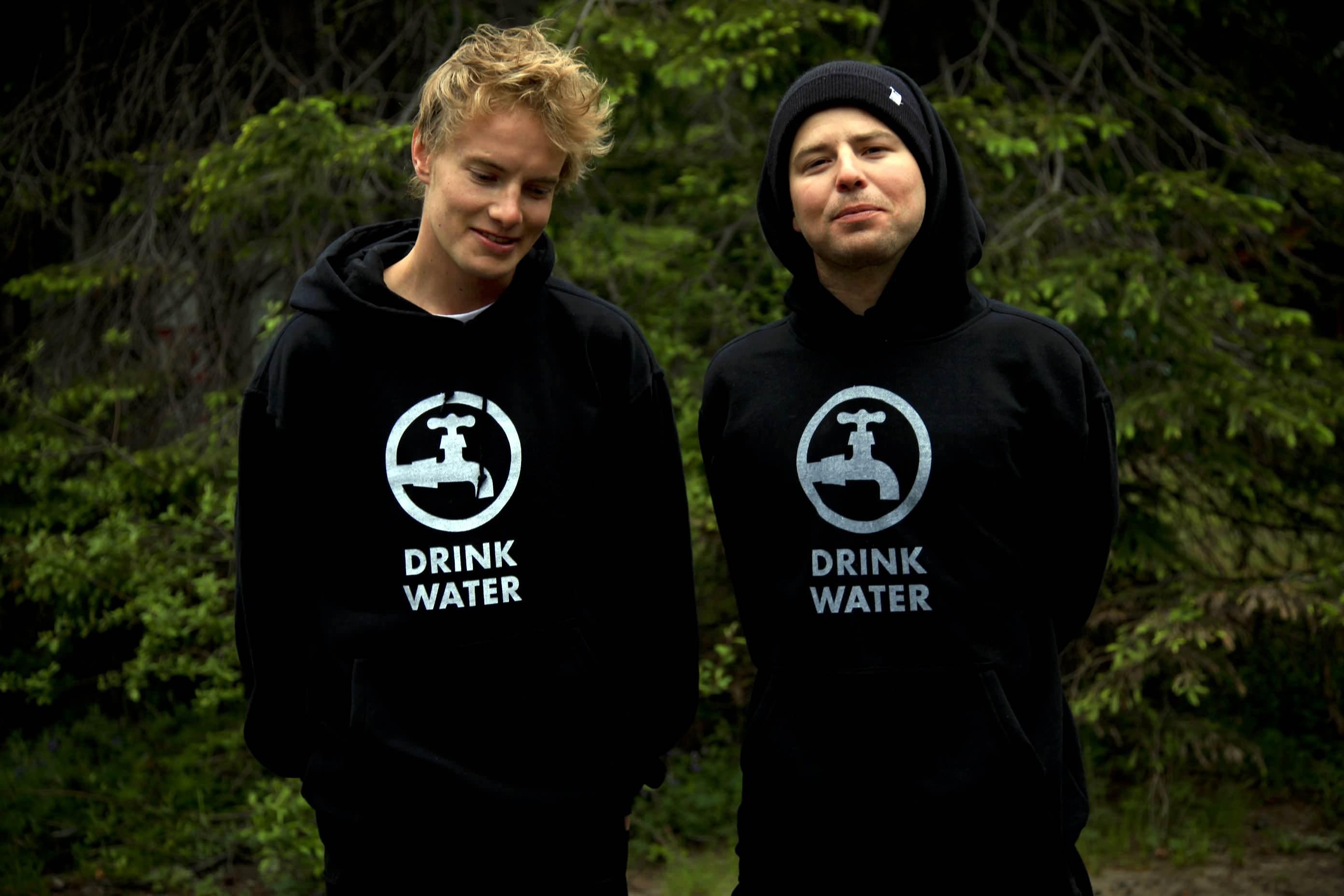
So who the hell am I to question people's lifestyle choices?  Well nobody really except I'm perfectly within my rights to be concerned.  I'm also pretty sure that from a nutritional standpoint these so called 'energy drinks' are actually a rapid way to ensure huge fluctuations in energy levels, problems with attaining proper sleep patterns and all the associated physical and mental health issues that subsequently arise.  Is there really any difference between Gee Atherton having Red Bull adverts all over his kit to him having Marlboro ones?  What would the reaction be if Sam Hill sat on the hot seat and nervously chain smoked instead of supping from a can of Monster (and really, are we meant to believe that athletes of that calibre are actually drinking that shit?).  I'm not alone in these concerns either.  Pro snowboarders Bryan Fox and Austin Smith actually started a 'drink water' campaign in 2011 as a direct reaction to Smith being offered a lucrative deal from one of the drinks companies. They felt that as role models who kids aspire to be like, they should be sending a positive message of health, and we're not talking Volvic here, their logo is simply a tap.
Fair play to these lads turning down the cash and sticking up two fingers to the corporations.
Sorry, couldn't find a credit for this pic.  Contact me if it's yours.
So what am I saying?  Personally I think that all these energy drinks (and all fizzy drinks really) shouldn't be on sale to under 18's and should have hefty limitations on marketing, just like cigarettes. The links to all sorts of nasty illnesses, from the obvious diabetes and heart conditions to less obvious mental health issues have been documented many many times over.  Latterly, something much more instant and terrifying has come to light as the correlation between 'energy drinks' and the spate of sudden deaths amongst seemingly healthy young people have been further researched (check this out and there's loads more too).

The money and likewise the innovation that Red Bull bring into sport have undeniably assisted athletes but it's such a shame that those talented individuals have to push a harmful substance on to a vulnerable consumer group in order to pay their bills.  I'm sure some of them don't care one bit what they have to sell their soul for in order to buy shiny new crap but it's heartening to see that a few others do place their social conscience beyond economic factors.  If their actions can persuade just a few of the kids I see slugging that syrup at bus stops on the way to school to stop and think about the physical effects then they've done a worthwhile job.

Sunday, 22 February 2015

Rather you than me mate...

When I was younger and newer to this whole outdoor game it was seemingly the done thing to be into everything.  Paddling horrendously polluted rivers in a playboat, awesome!  Scottish Winter hot aches, love it!  Scared shitless and freezing on a dark Alpine face, bring it on!  As I've matured (?!) I've realised that actually there's a huge variation in what's happening in 'the Outdoors' and in reality some of it I've little interest in doing.  Likewise, there are clearly massive differences in personality type, motivation and levels of devotion required for different activities.   Walking in the Mournes and then going for a coffee is a lot less involved than new routing on a secluded crag but I'm sure it's no less satisfying to the people that love their chosen activities.

For me, I've had extended periods of being obsessed with mountaineering, climbing and fell running with mountain biking being the constant love that still lasts after over 25 years.  Getting out running or on the bike is so second nature now that I often find myself in the forests or mountains before I'm really conscious of what I've chosen to do that day.  The thing is, my favourite pastimes invariably involve physical pain, suffering, getting cold and wet, occasional broken bones and lots of cleaning, maintenance and expenditure.  So the often asked question is why the hell do we do these things?

We've all heard the ultimate answer to this question, 'because it's there' supposedly provided by George Mallory when probed on why he wanted to scale Everest by a New York Times journalist.  It's a great answer, sufficiently reasoned for those of us who understand and suitably vague and infuriating to those who don't.

However much I appreciate that quote it is a bit grandiose when considering why it is that I, and my friends and peers do the things we do day to day.  I feel priveleged to be in contact with many inspirational people who are regularly pushing their limits, experiencing life despite discomfort and danger and yet I'm still not sure many people appreciate the reason why they pursue these goals.

We live in a world seemingly ever more removed from genuine experience where the rush to share (boast) via social networks often seems to be the actual goal of the activity in the first place (and the irony of me blogging about it isn't lost on me).  I'm not sure whether this is a new phenomenon.  The 'outdoors' seems to have always been full of blaggers, wannabes and bullshitters.  They just used to hang out in the pub/outdoor centre/shop telling anyone who'd listen about their latest supposed adventures.  The internet has given these folk the chance to instantly share their 'achievements' with infinitely more people and soak up the plaudits for their 'extremeness' from their Facebook friends.  These aren't the people I'm talking about because the answer to the question 'why' for them is simple.  They want recognition and they want to purvey a certain image and that's their prerogative.

I love looking through old pics to remind myself why!
The ones I really want to ask 'why?' are a little harder to track down largely because they're out there doing the very thing they love.  They to me are the true heroes but why the hell do they do these things?

Having thought about it a bit I've realised that I've already answered my question, it's because they love doing these things.  So I guess the correct question to ask is not why they do it but why do they love it?

Yesterday myself and big Seamy ran up the frozen face of Slieve Donard and over to Slieve Commedagh getting cut in half by a howling and freezing gale, crawling on hands and feet in places.  Seamus managed to leave his leg bruised and bloodied when the top layer of a frozen bog gave way and the ice sliced and smashed his leg, not that he noticed in temperatures that must have been around minus 15 with the wind chill.  I couldn't feel my face at all coming off the Commedagh summit and I wished I couldn't when the feeling returned and the burning began!  And did I enjoy it?  Yes absolutely.  I enjoyed it at the time and I really enjoyed it retrospectively.  Why do I love it?  The exercise, the fitness, the challenge, the camaraderie, the views, the fresh air etc etc.  I guess if I asked my mates why they love what they do I'd get a similar list.  Does that activity appeal to many people?  No it definitely doesn't.  I tend to get a 'fair play but rather you than me mate' response and that's from 'outdoorsy' people not to mention the 'normal' public out there.  Each to their own and many prefer a trip to the gym, an afternoon in the pub or even open boating!

Everyone's Everest is different and I guess I did run up Donard because it's there.  It would've been a lot harder running up there if it wasn't!

Keep chasing your Everests folks! 

Saturday, 6 September 2014

Oxygen Debt - The World Mountain Running Championships

August 1992 - 14,000 feet above sea level

I bent double over my ice axe and glanced upwards.  Mont Blanc's tin box Vallot Hut didn't appear to be any closer than at my last agonised look, hardly surprising given that in the ten minutes since then I'd barely managed twenty steps.  The afternoon sun warmed my neck as I gulped in air, desperate for that reassuring feeling of deep breath hitting the bottom of my lungs.  The headaches and nausea were a portent of the horrendous night I had in store and the impending storm wasn't the main reason that there would be no summit attempt that year.  Welcome to 14,000ft Mr Bailey, now get back to the valley where you belong...

August 2014 - 14,000 feet above sea level

Where the hell is the A-Frame?  We're above the treeline and moving well but there's been no sign of the structure which definitively marks the transition to the open mountain section, the section I'd been repeatedly warned about in the last 48 hours, the one that reduces World Class athletes to arthritic wrecks.  My world has diminished to just the few metres directly in front of me.  Scotland's Claire Gordon is pushing a solid pace, still running towards a superb category win for her.  I'm more than happy to tuck in and keep pace, I was told we wouldn't still be running at this point, I was told wrong...

The Pikes Peak ascent and marathon is world famous amongst endurance athletes and mountain runners.  The ascent section climbs a massive 7,815 feet over 13.32 miles of constant uphill over trail and open scree slopes.  This year it had been selected to host the World Long Distance Mountain Running Champs adding even more prestige to one of the most coveted titles in running.
Pikes Peak in the background (from halfway down it)
Personally I'd spent the whole of last Winter telling anyone prepared to listen that I was done with competetive running and was returning to mountain bikes.  Damaged thumb ligaments in November and a call to arms from the Newcastle AC Cross Country squad had realigned my ambitions for 2014.  The possibility of representing NI at Pikes Peak and getting a trip to Colorado cemented them, I was destined to train harder and race better than ever before.  A mantlepiece full of trophies is testament to the success of the racing but the pure enjoyment and fitness gains from my longer runs in the Alps, Lake Garda and the Mournes also showed me that I could make the transition to longer distance racing from my usual five mile sprints over the peaks.  Final training efforts went brilliantly and it was with growing excitement that I realised that I'd be heading to the States not just injury free but also in superb form.

The 25 hour journey passed mostly without incident through Dublin to Colorado Springs via Chicago despite a desperate drive from the airport accidentally taking in the long stay car park and some tunnel visioned, sleep deprived Interstate terror.  On the way I'd met my NI team mates Justin Maxwell and Chris Stirling and waiting at the accommodation was Peter Bell.  The team was complete and full of excitement for the challenge ahead.  Despite the exhaustion of the journey the time difference played its tricks and I lay awake from 3am, struggling to relax but consoling myself that it'd make getting prepared at 4am on race day an easy prospect.
Where we stayed was none too shabby!
Having arrived a day earlier Peter had taken the brave move of walking the full Ascent course the day we arrived and so was full of useful information, the summation of which was that it was going to be seriously hard and that the lack of oxygen is a very real factor.  Having been out of breath on the stroll to the castle (yes castle!) for our breakfast I wasn't about to doubt how strenuous running would be at twice that altitude, however, we needed to experience it for ourselves.  We headed to Manitou Springs, parked up and ran a steady hour up the 'W's' to 'No Name Creek', about a quarter of the full ascent distance.  I have to admit that I was delighted how sprightly my legs felt, lacking the expected hangover from being cooped up on American Airlines flights for so long (basically it was like a long-haul Ryan Air!).  However, the thin air even below 8,000ft was alarming.  Any short increased effort put me in the red for way longer than it should've and I felt that I was only operating at about 60% of my lung capacity.  As such, I had mixed emotions as we enjoyed a brilliant jog down the switchbacks we'd just climbed.

Thursday evening we were joined by Dr William Elliott, renowned physiologist and seven times Pikes Peak veteran.  I'd been really looking forward to meeting him and gleaning as much information as possible about the challenge ahead.  I've never been faced with any event that has so many inherent uncertainties before and so soaked up his words of caution and inspiration intently.  After giving us a really detailed breakdown of the course and the efforts required, particularly for us sea level dwelling 'flatlanders' as we're known in mountainous Colorado he asked us for our predicted finish times.  I was caught in two minds, reveal my prior estimate (prior to the continuous warnings to go VERY easy for the first 7-8 miles since we'd arrived) or play safe and avoid risking looking like an idiot.  Being someone who is familiar with being driven by a risk of failure and not being overly averse to looking an idiot I stuck to my guns and gave a firm and confident sounding 'sub 3 hours'.  The reality in my head was that I had no clue whether I'd be much nearer the men's average time of 4:20.
Team NI psyched and ready to race
Race day started at 3:30am and for the first time ever I was praising the effects of jet lag as I took a night time warm up jog outside.  I felt awake, focused and really excited, any trepidation was hidden at the back of my conscience and I was delighted to finally be getting on with the thing that had been my focus for so long.  The World Mountain Running Association laid on transport to the start and it was quite amusing to see a queue of identical people carriers pulling up to the accommodation, the sort of thing you normally associate with FBI raids in crap detective films.  Arriving in Manitou Springs there was already a palpable buzz in the air, the sun was starting to appear in a beautifully clear sky and nearly 2,000 runners were trying to go through their warm up routines in the confines of the main street.  Team NI were all looking relaxed, posing for some souvenir pictures and laughing at the athletes who felt the need to add intense sprints to their warm up for a 13 mile uphill race, each to their own I guess.  I'd decided the day before to heed all the advice and set off extremely easy so as the countdown finished and the gun sounded I relaxed into the easiest race pace I've ever used and allowed a couple of hundred people to run past.  I'll continue from here with my stream of consciousness as it does allow you all to appreciate the inane thought processes that take place during these events!

Mile 1, relax, steady, don't chase.  People are streaming past and I could easily keep up with them.  This is contrary to all my usual race tactics but I'll see many of these people again when they're dying higher up.  Ignore the cheering crowd, ignore the pride, focus on the pace, find a rhythm.

Miles 2-4, this is too slow.  I feel far too relaxed.  I'm practically jogging and not even breathing hard, I warn people passing me to take it steady but most ignore me.  Some are wheezing and breathing really hard, I laugh internally.  Get passed by someone with a Go-Pro strapped to their head, a f***ing Go-Pro!!  This isn't a serious runner.  Have to fight the urge to pass him, bury him, teach him to respect the race and the mountain but relax, back to the rhythm.  Pass No Name Creek, into unknown territory.  Start passing the victims already including a South African I've been chatting to a bit, I tell him to relax, he tells me he's already in survival mode.  He's in for a very long tough ordeal and I'm still not even breathing hard.  I think the advice may have been right!

Miles 5-7.5, finally off the leash.  The course has flattened and I'm kicking on.  Ding Dong battle with a Polish runner, he's faster on the flats, I pass when it steepens.  Lost in personal competition we pass a dozen others.  Drink, measure effort and get a real sense of enjoyment.  Push on towards the half way mark and 'Barr Camp'.  I know I want a gel just before the aid station but how will I know where it is?  I hear it hundreds of metres before I see it, this is the USA, enthusiastic crowd support is practically a National passtime.  I really appreciate the shouts, almost as much as the Gatorade but what the hell does 'yeeeehhhhh represent real good' actually mean?  Check my watch, bang on 3hr pace, satisfaction.

Miles 8-10, I've read the course notes, I know that mentally these are the toughest miles.  Over half way but not yet on the open mountain, like a no-man's land of extreme effort.  Steeper narrower trails, uneven steps, legs rapidly deteriorating but I'm still passing people, still pushing on.  Cramping, out of the blue, really didn't expect that.  Been chugging the Gatorade but must've sweated much more than I thought.  Stuff in a salt capsule, unbelievably disgusting, instant relief.  Push on, enjoy the pain.

Miles 10-13, the open mountain.  I've read and been told so much about this section.  'It's unrunnable', 'it'll destroy runners', 'people lying and puking everywhere'.  Like anything built up that much it's an anticlimax.  Contouring trails are 90% runnable, don't walk, I haven't come all this way to walk.  Stick to Claire, she's going well and we're still passing athletes.  The body feels OK but the head is all over the shop, overwhelming dizziness, vision looks like it's through a filter, fuzzy peripheries.  I fall on to boulders deliberately to avoid falling on them accidentally.  No summit, does this mountain have a summit?  Why the hell does this fella keep sprinting past and then stop in the middle of the track?  Dickhead!

Miles 13-13.32, 'go on, you can make sub 3' shout the wellwishers.  I know this already, my pacing has been perfect.  I will make sub 3.  Just a few more short switchbacks, the finish, kick out a sprint, I always kick out a sprint.  2:56:50.  Medal round my neck.  Medics ask 'are you OK?'  Yes I'm OK thanks, but the dude who kept sprinting past isn't, he's collapsed at the finish.  I've done it, a rush of emotion, surrounded by smiles, I think I enjoyed that!

The next half hour...
I'm a firm believer that you have to grab your finish line emotion and hold on to it hard.  Like a snapshot, how do I feel right at this very moment?  If you wait even five minutes til the heart rate is down and the head is clear then you can forever be left with the unanswerable question, 'was that my best'?

As I crossed the line I felt great.  Even sitting here long after, even despite the drunken fuzziness of altitude I can still recall a deep satisfaction.  I wandered through the other international runners, chatting away.  Some were already displaying that post-race malaise, could've, should've, if only.  Pretty soon my thoughts will go the same way but that finish line sense of pride, completion, discipline, effort, pain and realised ambition has been banked and I'm all the better for that.

Summit smiles, just after the finish
Justin arrived shortly after and Chris soon after that.  The cameraderie of Team NI felt very real as we captured the obligatory post race pics, smiling faces with an astounding background vista.  I barely know these lads but I'm extremely proud to be associated with them, shared experiences that will last a lifetime.

The next ten hours...
Amongst the best of my life!  So many highs, enhanced by the mass euphoria of a town overflowing with endorphins.  Free pizza and beer (thanks WMRA), massages (thanks Billy) and easy conversation with some genuine running legends, normal people with abnormal abilities.  On the hour long drive down from the summit we got chatting to 3rd place finisher Andy Wacker, a phenomenal athlete and really nice guy.  He insisted on driving us to the team USA post-race pool party where we relaxed and drank amazing local beers with many of our fellow Internationals.  The chat was engaging and fun, I love being surrounded by people who do, not just dream of doing.  Next challenges were discussed, I'd better think of one myself.  The party wound down before midnight, virtually everyone there would train the next day.

Top of the infamous 'Incline'
The next few days...
Everything looked a bit different.  The subconscious weight of nerves had disappeared and I enjoyed everything massively, even the mundane tasks of shopping and driving around.  We ran the day after the race, a steady 13 miler with the hellish 'Incline' ascent at the end, a 3/4 mile long, 2000ft elevation gain climb which hits 68 degrees at its steepest point.  The following two days I did some of the best biking of my life, brilliantly guided by Kip, an ex-pro racer who showed me just a few of the incredible local trails including a 41km descent back off Pikes Peak.  It's no easier on the way down!  We ate lots, ran more and soaked up as much of the stunning scenery and effortless hospitality of the American people as we could.  As ever my mixed emotions of missing Anna and the boys began to tip the balance towards feeling ready to leave and so a perfect trip ended at the perfect time.
About to descend Pikes Peak.  Worth the trip just for this 36km of singletrack!
Postscript, what did I learn?

1) I'm not a World Class athlete.
Sage Canaday (Team USA) won the race in 2:10:03, nearly 47 minutes faster than me!  He is World Champion, I never will be.  No real surprises there!  I finished 81st of 1,760 starters and 14th in my age category, not bad for a flatlander!

2) I'm nowhere near as far off as this result would suggest.
The defining factor in this race was, as predicted the altitude.  I have no doubt at all that had it started at sea level I'd have been way up the field.  My 'Triple Donard' final training session ascent times were a combined 2:10:05 and that comprised over 200m MORE ascent than Pikes Peak as well as being steeper and on looser ground.  You could argue that I had the recovery time on the downhills inbetween but anyone familiar with running hard down steep ground will tell you that the opposite is true.  Team USA dominated Pikes Peak and they all live and train at altitude.  Likewise, it's safe to assume that all the athletes from the Alpine countries have been brought up in or moved to the mountains to train and race.  One of the Germans lived on Pikes Peak for the 17 days preceding the event, the others used oxygen tents and masks.  Team England had to commit to being in the States at least two weeks before the race etc etc, moan, excuses!  Team NI would've loved to have been out there long enough to acclimatise but we're part-timers with jobs, young families and very limited funding.  I'm happy I did the very best I could in terms of prep but was defeated by the unique attributes of the race.  

3) Could I have pushed harder?
This question is one I've pondered hard.  I definitely heavily heeded the advice to go easy for the first half and felt more comfortable than ever before in a race.  As a result, despite being a sea level dweller I actually picked up ten places in the real high altitude section above 10,000ft.  I wasn't going any faster but others were dying on their feet after clearly going out too hard.  I could definitely have gone 15 minutes quicker to No Name Creek and probably another 10-15 quicker up to Barr Camp, the question is would that have killed me in the second half of the race?  In truth, unless I do it again I'll never know.  If I did get the chance to do the race again I'd definitely run it in a completely different manner, going off with the leaders before settling into my own rhythm further up the mountain when they kicked on.  I'd love to go back for the marathon at some point but pushing hard in the first five miles of twenty six would be even more ill advised so I'll probably have to accept that I'll never truly know the answer to this one.

4) Colorado was amazing.
I love the USA!  As a natural cynic I always thought the over the top friendliness of Americans would feel insincere, an act put on for the tourists.  I couldn't be further from the truth.  The overwhelming openness and enthusiasm of people I met, from professional runners to garage attendants was completely infectious.  I felt like a different person out there, talking to total strangers felt so natural.  I met some truly interesting, interested and engaging people from all ages and walks of life.  Couple this with beautiful accommodation, great weather, stunning mountains, top drawer running and biking, cheap and good food and it was obviously going to be a truly memorable trip.  I'd love to get back there again.
This sums up Colorado Springs.  The Jack Quinns Tuesday night 5k sometimes gets 2,000 participants!
Being a part of the World Champs and Pikes Peak race was an incredible opportunity and experience which I earned through hard training, solid domestic race results and being prepared to stump up a large proportion of the cash required myself!  Massive thanks to Anna who is always so supportive of my 'holiday' plans and who I'm sure had a hard time looking after the boys and also working all hours whilst I was away.  To my fellow NI team mates Justin, Chris and Peter, you were brilliant and easy company as well as being great athletes and training partners.  Big mention to Dr Billy Elliott for the top advice, endless support and friendliness and for being the best possible advocate for the race and Colorado in general.  The WMRA looked after us very well and the runners from all over the world made the event truly special along with the Colorado locals who were all so accommodating.  Thanks also to Feetures Socks, 2Pure, NIMRA and Newcastle AC who all contributed in different ways.

To any runners looking for a challenge it's pretty clear from the tone of this blog that I enjoyed the Pikes Peak ascent.  I'd really highly recommend you do all you can to meet the entry requirements and get signed up.  It truly is an experience that'll stay with you for a lifetime.


Monday, 19 December 2011

Blogging


Having finally got round to setting up the blog things are now starting to take shape.  Together the three of us are working steadily away on the content for the site.  We have a rough programme for 2012 of different courses and events we hope to run, one quite interesting looking trip is to head over to Skye and climbing the famous Cullin Ridge  We are also hoping to run regular day trips to Fair Head and bike tuition in the forests around the Mournes to name a few.


So I guess that is the first official blog!

Merry Christmas and a Happy New Year from the R&R Team!